What does it mean to be Knowledgable
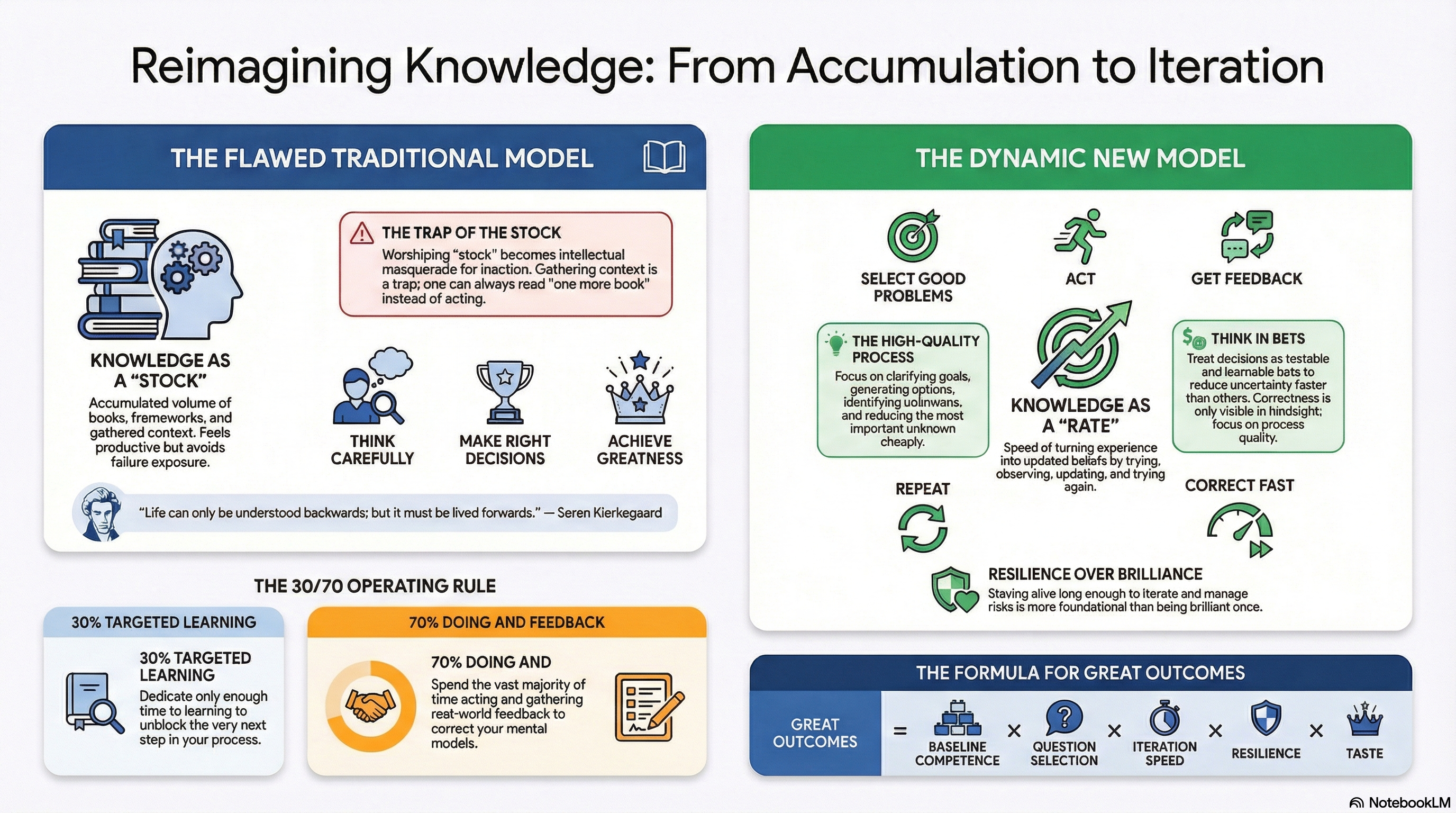
I used to think that the path to great outcomes looked like this
Build knowledge → think carefully → make right decisions → achieve greatness
I chased that model for years. However, almost every time, the real learning only started when I was forced to act. The “doing” taught me more in weeks than the preparing had in months.
The model I try to use now is
Select good problems → act → get feedback → correct fast → repeat
Learning and creating is less about making the correct decision. It’s more about learning faster and aiming better.
What “knowledge” actually means
Growing up, “knowledge” was the word people used to describe the high achievers, the well-read, the well-credentialed, the people who always had the right reference at hand.
What I’m learning is that knowledge falls into two very different buckets:
- Knowledge as a stock - what you’ve accumulated: books read, frameworks memorized, context gathered.
- Knowledge as a rate - how quickly you turn experience into updated beliefs: try → observe → update → try again. Loosely, it’s about updating your priors, quickly.
Most people worship the stock because it feels productive without any exposure to failure. You can always read one more book. But past a baseline, the rate matters far more.
Why “making the 100% right decision” is the wrong goal
You never act with full information. Our minds are evolved to make decisions in a resource-constrained environment, on partial data, with models that may be wrong in ways we can’t fully see.
So “the right decision” isn’t something you can reliably choose. Often, you don’t even know what “right” means at the moment of deciding. We only call decisions “right” in hindsight, once the outcome is known.
Life can only be understood backwards; but it must be lived forwards — Søren Kierkegaard
A better goal is to reduce uncertainty faster than others, while keeping downside controlled. If I can’t guarantee the right outcome, I can at least guarantee a good process.
A better frame for decisions is to think in bets, making bets that are testable, and learnable.
What actually matters
-
Decision process quality, not correctness
In uncertainty you can’t guarantee outcomes, but you can guarantee a good process: clarify your goal and constraints → generate real options → identify key unknowns → reduce the most important unknown cheaply → make a bet → review and update.
-
Learning loops
Good feedback loops will make you both knowledgeable and effective over time. Feedback is the only thing that corrects your mental models.
-
Problem selection and taste
What you choose to work on matters more than being 10% smarter.
-
Resilience
Staying alive long enough to iterate beats being brilliant once. Risk management is unglamorous but foundational.
A few things we’re conditioned to think matter
- Being the smartest person in the room
- Waiting for certainty before acting
- Gathering more context
A lot of this can quietly become a trap, like overfitting to existing explanations, or an intellectual masquerade for inaction.
A simple operating rule
Aim for a 30-70 split:
- 30% - targeted learning; enough to unblock the next step
- 70% - doing and getting feedback
If you find yourself flipping that ratio, ask honestly whether you’re learning or hiding.
Great outcomes = baseline competence × question selection × iteration speed × resilience × taste