Where Leverage Lives
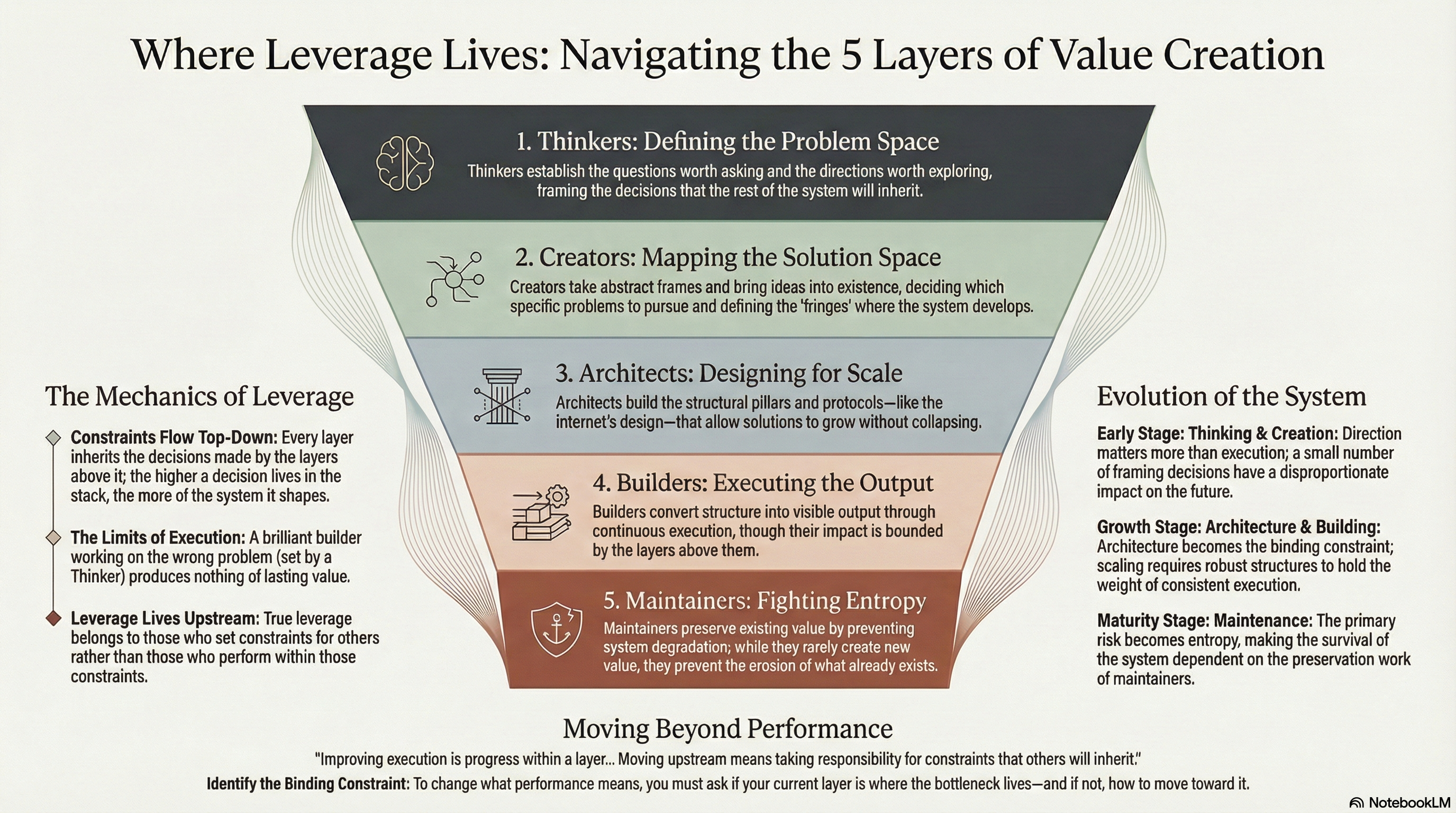 Every system that creates value, be it a company or a scientific innovation, has largely a similar structure. Upstream decisions that set the conditions for everything downstream. Constraints flow top down, and Leverage lies to whoever sets constraints for others.
The Layers
Any value-creating system can be understood as a stack of five layers
- Thinkers Thinkers define the problem space, i.e. questions worth asking, and directions worth exploring. Most systems inherit their problem space from a small number of framing decisions.
- Creators Creators take an existing frame and bring a idea into existence. They decide which problems (from the problem space) to pursue and map them to a solution space. Without creators, the thinking remains abstract, as a concept. A creator’s output becomes the fringes inside which the system develops.
- Architects Architects form the key pillars for the system to stand upon, eg. internet’s protocol design. They are responsible to design the structures that allow a solution to scale. Often, creators and architects are the same layer. They determine the necessary components, how they interact, and how to grow without collapsing. The design compounds over years, shaping the possible paths for everything and everyone that comes ahead of them.
- Builders Builders convert structure into output through continuous execution. This is where most visible work happens. Builders are essential, but their impact is bounded by and a function of the decisions made in the layers above them.
- Maintainers Any system will degrade without active preservation, and Maintainers fight this entropy. Maintenance rarely creates new value, but without it, existing value erodes.
How constraints move within the layers
The stack is a description of dependency. Every layer inherits the decisions made by the layers above it. The value any layer produces is real, but it is bounded. The higher a decision lives in the stack, the more of the system it shapes.
The system in motion
The actors in any layer are not static. The system allows them to move around.
-
In early stages, thinking and creation dominate. A small number of framing decisions have a disproportionate impact, and getting the direction right matters more than executing well. A brilliant builder working on the wrong problem produces nothing of lasting value.
If Henry ford just listened to the people, he would have to build roads suitable for horses, or invest in breeding healthy and more number of horses.
- As a system grows, architecture becomes the binding constraint. The problem is defined, but scaling requires structure. Poor architecture limits progress regardless of how hard anyone works below it.
- During growth, building dominates. Direction is set and structure holds. Performance depends on consistent execution and iteration.
- In maturity, maintenance becomes critical. The primary risk is entropy, and the survival of the system depends on maintainers.
A layer that is critical in one phase becomes may important in the next. The structure allows an actor to move from a high-leverage position to a low-leverage one, if the have the capacity for it. Often, an actor has to put on multiple hats, eg. a CEO needs to think long term for the company, and focus on execution on the same day.
The principle
Improving execution is progress within a layer. The question isn’t just “How do I get better at my current layer?” It’s also: Is my current layer where the binding constraint lives? And if not: What would it mean to move towards it? Moving upstream is different: it means taking responsibility for constraints that others will inherit. Which means shaping the conditions, not merely performing inside them.
The constraint stack exists in every system. Most people never ask where they are in it. Fewer still ask whether they’re operating near the bottleneck. The ones who do don’t just perform better. They change what performance even means.